Who talks how much?
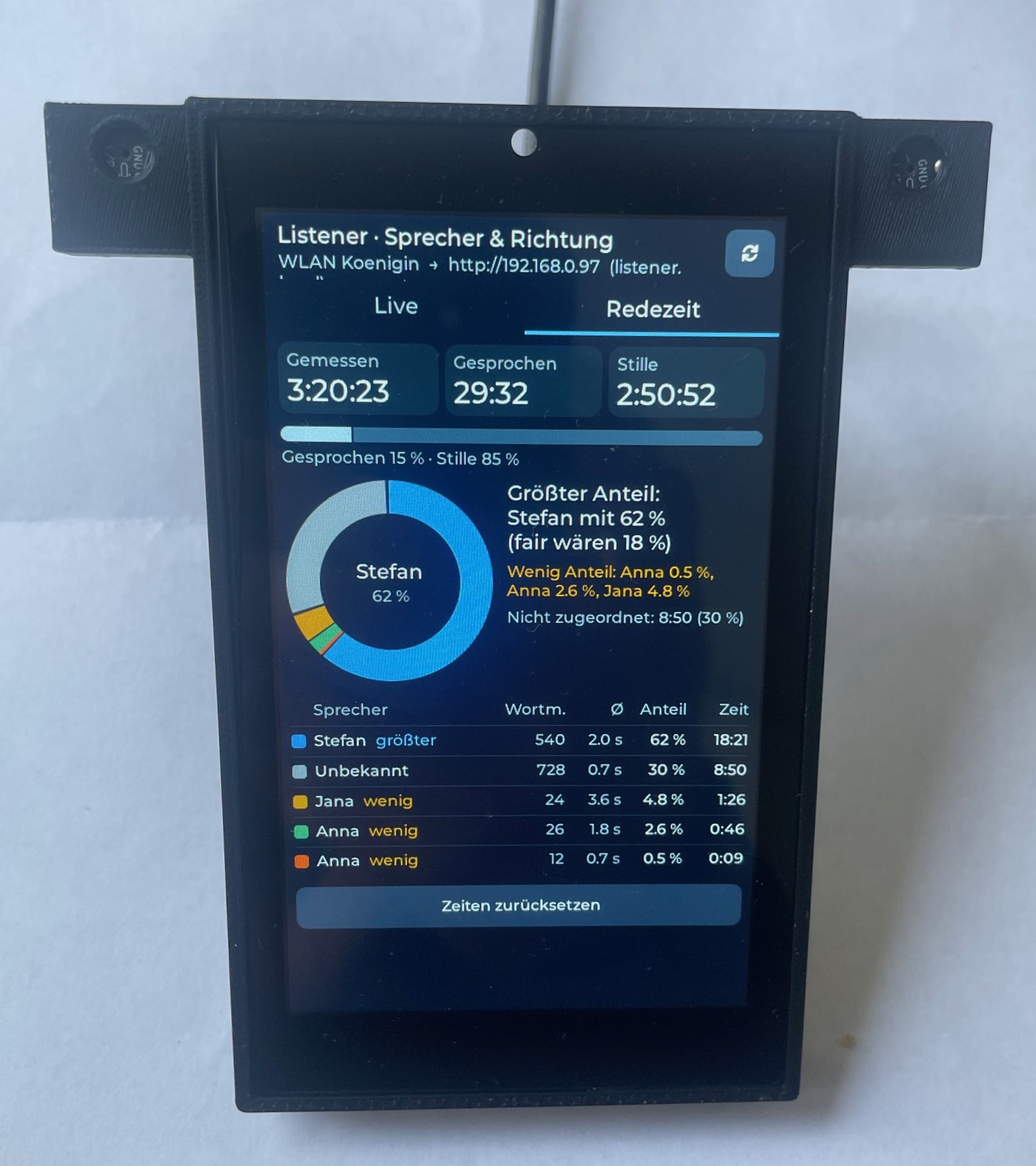
The Listener is a speaking-time display for meetings and group conversations. It measures how long each person speaks and shows everyone's share on a display, so dominant speakers notice and quieter people get their turn. For meetings as well as private groups.
Take the survey (German, about 3 minutes)Help us find out whether and what you would use a device like this for. The survey is in German.
The “Listener” effect: In groups with strongly asymmetric speaking shares, valuable ideas are often lost.
How it works
Put it down
The device sits in the middle of the table. Four microphones listen to the conversation and work out which direction each voice comes from.
Recognize voices
A neural network matches voices to known speakers, right inside the device.
See speaking time
The display shows who has spoken for how long. Everyone can see it and adjust.
What is a speaking-time display for?
In meetings
Whoever chairs the meeting sees at a glance how the speaking time is distributed and can bring quieter participants in.
In teams and workshops
Teams see whether only a few people hold the floor and practice more even participation.
In private groups
Family, club or friends: the Listener makes speaking shares visible without putting anyone on the spot.
Not a surveillance device
The Listener is meant to be a mirror, not a supervisor. The analysis runs inside the device itself, not in a cloud. The plan is that, in normal operation, no conversations are stored or sent to third parties. For testing, the prototype has a recording function (5 seconds) that is triggered by hand. We are also interested in your opinion on exactly this in the survey.
Frequently asked questions
What does the Listener measure?
Speaking time: how long each person speaks in a group. From that comes each participant's speaking share. The Listener does not judge what is said.
How does it know who is speaking?
Four microphones listen to the conversation, and a neural network compares the voices with trained voice profiles. This analysis runs directly in the device.
Are conversations stored?
The plan is that no conversations are stored in normal operation. The Listener does not analyze content; it only measures who speaks for how long. For testing, the prototype has a recording function (5 seconds) that is triggered by hand. How this looks in the finished device also depends on the feedback from the survey.
Is the Listener available yet?
No, so far there is a prototype. The survey helps us find out which features matter and what a device may cost.
Take part in the survey
Your answers help us decide which features matter and what the Listener may cost. The survey is in German.
Take the survey (German)